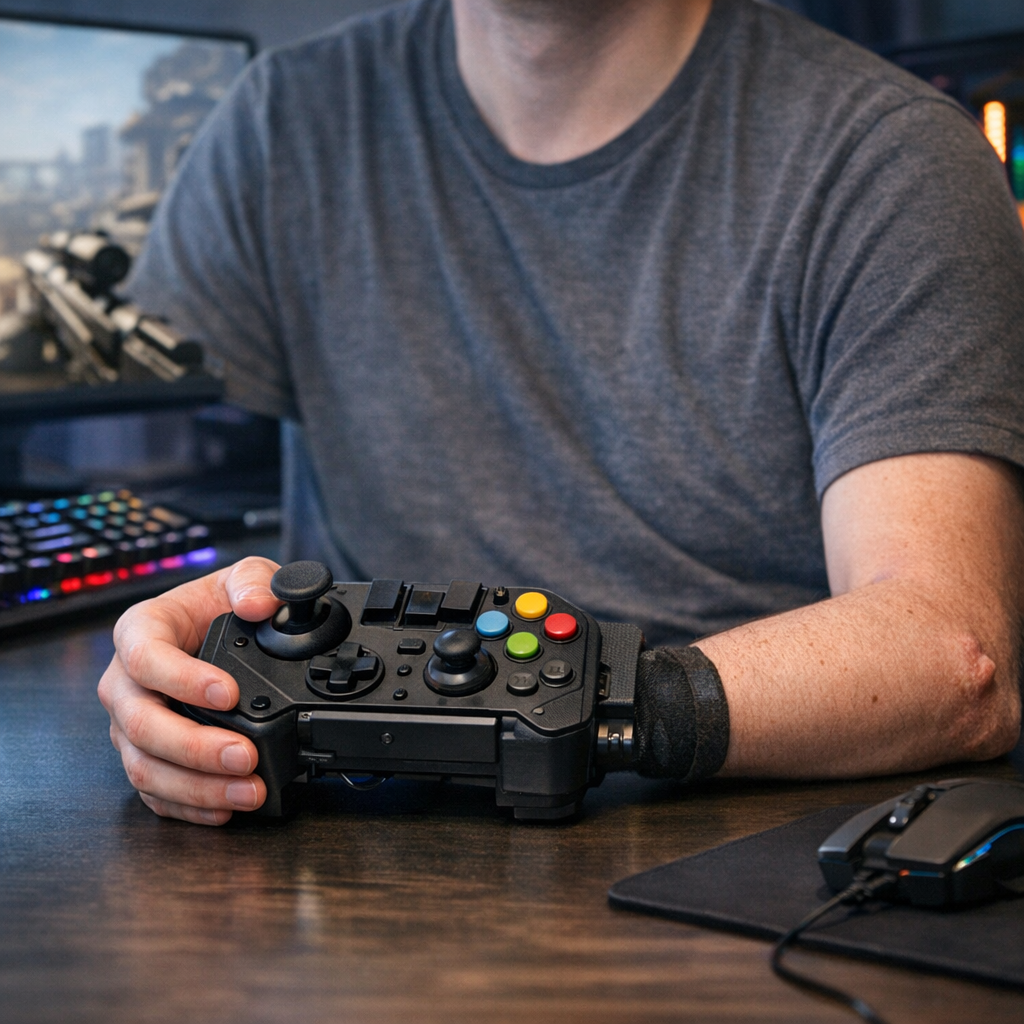
From Personal Hack to Hardware Startup
Five years after losing his right arm, one founder set out to solve a problem most of the gaming industry had overlooked: nearly every PC gaming setup assumes two fully functional hands. What began as a personal workaround—a custom-built one-handed controller blending keypad and mouse functionality—quickly caught the attention of both gamers and accessibility advocates. Now, with a provisional patent filed, an LLC formed, and a prototype in production, the journey has shifted from tinkering to true hardware entrepreneurship.
If you’re standing at this exact crossroads—waiting for your first prototype to arrive—you’re entering one of the most exciting and unpredictable phases of building a hardware startup. This article walks through what to expect, common pitfalls, how many iterations you’ll likely face, and when to start thinking about crowdfunding or partnerships. Consider it a practical roadmap for navigating the messy, rewarding reality of bringing a physical product to life.
The Reality of Your First Prototype
The moment your prototype shows up can feel like a finish line—but in reality, it’s the starting gun. First prototypes are rarely “almost done.” They’re proof that your idea can exist in the physical world, not that it’s ready for users.
Expect a mix of excitement and immediate frustration. Buttons might feel off, ergonomics may not suit real users, and components that worked in theory might behave unpredictably. This is normal.
For example, many hardware founders report that their first prototype reveals issues they couldn’t have predicted in CAD or simulations—things like hand fatigue after extended use, subtle delays in input response, or awkward weight distribution. In accessibility-focused products like a one-handed controller, these issues are even more critical because comfort and usability are central to the product’s value.
A helpful way to approach your first prototype is to treat it as a diagnostic tool. Instead of asking “Is this good?”, ask:
• What fails under real-world use?
• What feels unintuitive or uncomfortable?
• What assumptions did I get wrong?
• What surprises me?
This mindset shift prevents early disappointment and turns the prototype into a learning engine.
Suggested visual: A side-by-side diagram showing initial design vs. prototype with annotated differences could help readers understand how much can change between concept and reality.
Where Prototypes Break
Across industries, first prototypes tend to fail in predictable ways. Knowing these patterns ahead of time can save you weeks—or months—of confusion.
One of the most common problems is ergonomics. What feels right in your head (or even in a 3D model) often doesn’t translate to actual human use. In your case, where users may rely entirely on one hand, even minor discomfort becomes a dealbreaker.
Another frequent issue is component integration. Individually, parts may perform well, but once combined, interference can occur. Buttons may register inconsistently, sensors might conflict, or firmware may struggle under real usage conditions.
Manufacturing constraints also tend to surface early. Your prototype might work—but require expensive or impractical assembly steps. For instance, wiring that’s easy in a prototype may not scale cleanly into mass production.
Durability is another hidden challenge. Early builds often feel solid until they undergo repeated use. Stress points, especially in moving parts or frequently pressed buttons, can fail faster than expected.
Finally, user behavior itself can break your assumptions. People will use your product in ways you didn’t anticipate. This is particularly important for accessibility devices, where users may adapt the tool in highly personalized ways.
Suggested visual: A simple flowchart showing “Design → Prototype → Real-world use → Failure points → Iteration” could clarify the iterative loop.
Iteration: From Concept to Manufacturable Product
There’s no universal number, but most successful hardware products go through at least three to eight meaningful prototype iterations before they’re ready for manufacturing or crowdfunding.
These iterations typically fall into stages:
The first stage is proof of concept. This is where you are now—confirming that your idea physically works. It’s messy and experimental.
The second stage focuses on usability. Here, you refine ergonomics, responsiveness, and user experience. You’ll likely test with real users, especially those in your target audience.
The third stage is design for manufacturing (DFM). At this point, the product works well—but now you need to make it producible at scale, cost-efficient, and reliable.
A real-world example comes from companies like Logitech or smaller startups in the gaming accessory space. Many report that their “Version 1” never leaves internal testing. What customers eventually see is often Version 4 or 5, after layers of refinement.
For your controller, iterations may specifically focus on:
• Button placement and spacing
• Grip comfort over long sessions
• Input precision and latency
• Adjustability for different users
It’s better to expect multiple iterations upfront rather than hoping for a near-perfect first build.
Funding, Partnerships, and Hard-Won Lessons
Timing these decisions correctly can make or break your momentum.
Crowdfunding is often most effective when you have a working prototype that demonstrates clear value and usability—not just a concept. Backers want proof that your product exists and works, even if it’s not fully polished.
For accessibility-focused products, storytelling plays a major role. Your origin story—building a solution after losing your arm—combined with real user testimonials can strongly resonate with audiences.
Investors, on the other hand, typically look for evidence of demand and scalability. Early traction from online communities is a strong signal, but pairing that with prototype validation and pre-orders strengthens your position significantly.
Partnerships (with gaming brands, accessibility organizations, or distributors) often become viable once you can demonstrate both product functionality and market interest.
A practical timeline might look like this:
• Prototype 1–2: Internal testing and iteration
• Prototype 3–4: User testing and validation
• After validation: Launch crowdfunding campaign
• Post-crowdfunding: Approach investors or partners
This sequence helps reduce risk and builds credibility step by step.
Suggested visual: A timeline graphic mapping prototype stages to funding opportunities would help readers visualize progression.
Hardware founders consistently share a few lessons they wish they had learned sooner—and they’re especially relevant at your stage.
Test with real users as early as possible. It’s tempting to refine the product privately until it feels “ready,” but early feedback—especially from people who actually need your product—is invaluable.
Document everything. Keep track of what works, what fails, and why. This becomes critical when communicating with manufacturers or improving future versions.
Expect timelines to slip. Hardware always takes longer than planned. Build buffer time into every stage to avoid unnecessary stress.
Design for manufacturing earlier than you think. Even small decisions—like screw placement or cable routing—can significantly impact production cost and complexity.
Protect your energy. Hardware development can be emotionally draining, especially when progress feels slow. Treat setbacks as data, not failure.
Finally, don’t overbuild too early. Focus on the core functionality that delivers value. Extra features can come later, but complexity early on can stall progress.
Formatting note: This section could be presented as a clean bullet list or checklist in a published version for quick readability.
Your first prototype isn’t the destination—it’s the beginning of a deeper, more informed phase of building. Expect imperfections, embrace iteration, and lean heavily on real user feedback to guide your decisions.
Most successful hardware products are shaped through multiple cycles of testing, failure, and refinement. By understanding what’s ahead—common issues, realistic iteration timelines, and strategic funding moments—you can move forward with clarity instead of guesswork.
What you’re building goes beyond convenience; it addresses a meaningful gap in accessibility and gaming inclusivity. That makes the process not just technically challenging, but genuinely impactful.
Stay focused on learning quickly, improving steadily, and validating with real users. That’s what turns a promising prototype into a product people truly rely on.
References and Further Reading
For deeper insight into hardware development and startups, consider exploring:
• “The Hardware Startup” by Renee DiResta and Brady Forrest
• “Making Embedded Systems” by Elecia White
• Y Combinator’s Startup School (hardware-focused lectures)
• HAX Accelerator resources on hardware prototyping and manufacturing
• Articles from IEEE Spectrum on product design and engineering challenges
These resources offer both technical guidance and real-world perspectives from founders who’ve navigated the same path.